


DPDP Compliance Checklist for IT Companies
Key Takeaways
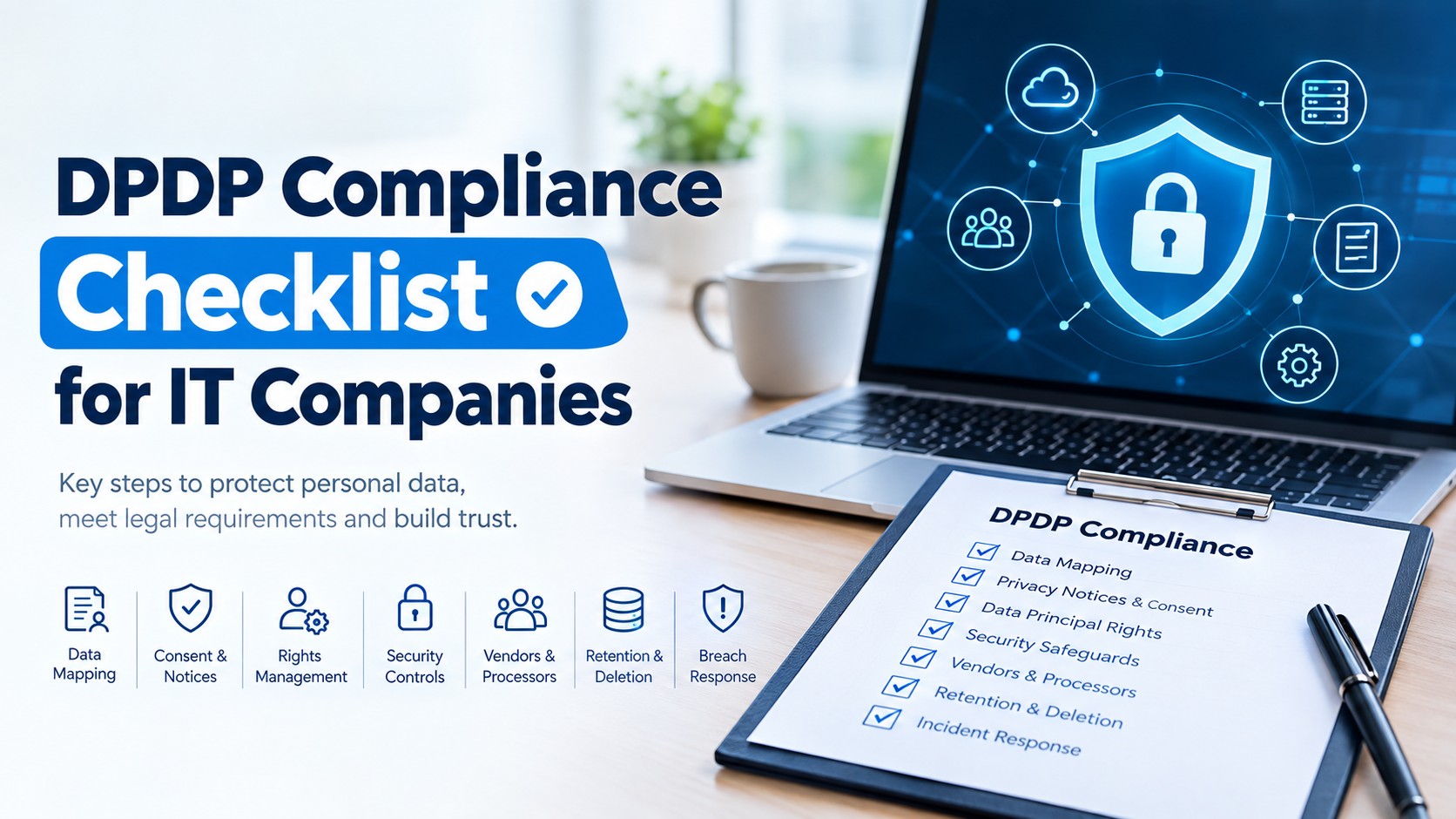
- A DPDP compliance checklist should cover data mapping, notices, consent, rights management, security, vendors, retention, and breach of response.
- IT companies should identify whether they act as Data Fiduciary, Data Processor, or both in different business relationships.
- Privacy compliance should be considered across applications, cloud environments, employee systems, and third-party platforms.
- Security controls and documented incident-response procedures are important parts of a broader compliance program.
- DPDP compliance is an ongoing process that should be reviewed when products, vendors, systems, or data-processing activities change.
IT companies can handle personal data across almost every part of their operations, from customer accounts and employee records to SaaS platforms, applications, cloud infrastructure, analytics, and support systems. That makes data protection more than a privacy exercise. It requires organizations to understand what personal data they process, why they process it, who can access it, and how it is protected.
For businesses preparing DPDP compliance for IT companies, a structured review can help turn broad legal obligations into practical actions.
- Map the Personal Data You Process
Start by creating an inventory of personal data handled by the organization. Identify what information is collected, where it enters the business, where it is stored, why it is processed, and which internal teams or external providers can access it.
For an IT company, this review may include customer information, employee records, account credentials, support tickets, payment-related information, application data, and information processed through cloud or SaaS platforms.
Without a reliable data map, it becomes difficult to determine which DPDP compliance requirements apply to processing activities.
- Determine Your Role in Each Data Flow
An IT company may not have the same role in every relationship. Under the DPDP framework, a Data Fiduciary determines the purpose and means of processing personal data, while a Data Processor processes personal data on behalf of a Data Fiduciary.
This distinction is particularly relevant to software companies, technology service providers, cloud businesses, and outsourcing organizations. Documenting these relationships can help clarify contractual responsibilities and internal compliance with ownership.
- Review Privacy Notices and Consent
Explore the way your organization informs the people concerning its processing actions and how it acquires consent if the relevant ground is consent.
The DPDP Act compliance checklist should cover privacy notices, consent mechanisms, withdrawal processes, and the channels through which individuals can exercise their rights.
The Digital Personal Data Protection Rules, 2025 provide additional implementation requirements concerning notices and related mechanisms. Organizations should review the official MeitY Digital Personal Data Protection Rules, 2025 when updating their compliance processes.
- Create a Process for Data Principal Requests
IT companies should have a defined process for receiving and handling requests from Data Principals.
Rather than leaving these requests to individual departments, establish ownership, verification procedures, response workflows, escalation points, and appropriate records. Customer support, legal, privacy, and technology teams may all need defined responsibilities depending on the organization’s structure.
- Review Security Safeguards
A DPDP compliance checklist should also examine how personal data is protected throughout its lifecycle.
Review access controls, authentication, monitoring, logging, vulnerability management, backups, encryption where appropriate, and other safeguards relevant to the organization’s systems and risks. Security measures should extend beyond the primary application to databases, endpoints, cloud environments, integrations, and other systems that process personal data.
- Prepare for Personal Data Breaches
Document what happens when a suspected personal data breach occurs.
The organization should know how incidents are identified, escalated, investigated, contained, documented, and communicated. Assigning responsibilities before an incident occurs can reduce confusion when different technical, legal, compliance, and management teams need to act quickly.
- Assess Vendors and Data Processors
IT businesses commonly rely on cloud providers, SaaS platforms, analytics services, consultants, hosting companies, and other technology vendors.
Evaluation of third parties’ actions regarding personal data, from receiving specific information to the protections that apply in a case of an agreement being signed. Also, reviews of vendors should describe the fate of personal data after the ending of any service relation.
- Establish Retention and Deletion Practices
Personal data should not simply remain in systems indefinitely because deleting it has never been prioritized.
Identify applicable retention requirements and establish processes for deletion or appropriate handling when data is no longer required for the relevant purpose, while accounting for other legal or contractual obligations that may require retention.
- Review the Program Regularly
The DPDP Act compliance requirements should not be treated as a one-time checklist.
New applications, business models, vendors, analytics tools, employee systems, and data-processing practices can change an organization’s privacy risk. Periodic reviews can help ensure that policies and controls continue to reflect how the business actually operates.
For organizations that need help interpreting legal obligations alongside technology and information-security practices, Cyberra Legal Services brings together cyber-law advisory and compliance-oriented expertise as part of its broader techno-legal services.
A DPDP Checklist Across the Data Lifecycle
A practical DPDP compliance checklist should follow personal data throughout its lifecycle:
- Collect: Identify what data you collect and why.
- Store: Know where personal data is stored, including cloud systems and backups.
- Use: Review who can access it and for what purpose.
- Share: Identify vendors and processors that receive personal data.
- Retain: Define how long data needs to be kept.
- Delete: Ensure data is removed from relevant systems when it is no longer required.
Frequently Asked Questions
1. What is a DPDP compliance checklist?
A DPDP compliance checklist is a practical framework for reviewing areas such as data mapping, notices, consent, Data Principal rights, security safeguards, breach response, vendor management, and retention practices.
2. Why is DPDP compliance important for IT companies?
IT companies can process personal data through applications, websites, cloud platforms, employee systems, customer databases, and third-party services. A structured compliance programme helps identify responsibilities across these different environments.
3. What are the main DPDP compliance requirements for IT companies?
The relevant requirements depend on the organization’s role and processing activities. Areas to review include data governance, notices and consent, Data Principal rights, security safeguards, breach response, processor relationships, and data retention.
4. Is DPDP compliance a one-time exercise?
No. IT environments and data-processing activities change frequently. Compliance reviews should therefore be repeated when organizations launch products, change vendors, introduce new technologies, or significantly change how personal data is processed.
5. When do the DPDP Rules, 2025 take effect?
The Rules use a phased commencement structure. Some provisions took effect upon publication, while others commence one year or 18 months after publication. Organizations should check the official MeitY notification for the applicable timeline rather than assuming every provision applies simultaneously.